
How Does Facial Recognition Work?
Facial recognition technology has become increasingly prevalent across various industries, finding applications in security and law enforcement, smartphone authentication, and even enhancing user experiences.
To an observer, the entire facial recognition process appears relatively simple. It happens so quickly that most do not notice that this process is being done in stages. But there are a series of intricate mechanisms happening behind the scenes.
What Is Facial Recognition?
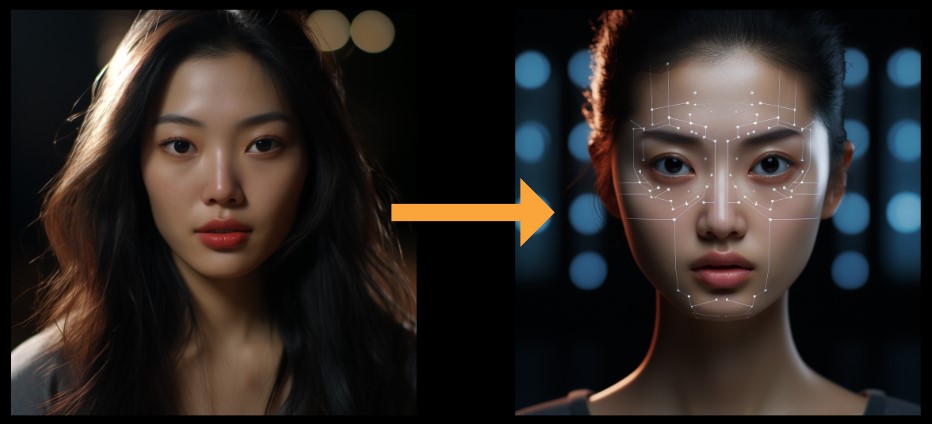
Facial recognition technology is a biometric technology that actively analyses the unique and distinct features of an individual's face to identify them. This technology analyses face patterns and shapes — creating a distinct template known as facial data. This facial data is then used in the identification process.
Facial recognition technology also extends its capabilities to recognise faces within videos, even when a person's face is partially concealed. Although this technology can identify individuals solely based on their faces, it is commonly implemented in combination with other authentication methods such as fingerprints, RFID cards, or QR codes. This integration enables two-factor authentication or multi-factor authentication which improves security measures.
How Does Facial Recognition Work?
Facial recognition software relies on artificial intelligence and machine learning algorithms to analyse an individual's facial characteristics and verify their identity.
By scanning each face, the software extracts unique identifiers and compares them against a database of images for identification purposes.
Although facial recognition systems may differ in their functionalities — they generally follow a five-stage process:
<li style="list-style-type: none;">
<li><strong>Facial Detection</strong><img  src="/uploads/blog/2023/06/screenshot-2023-06-23-165355.jpg" alt="screenshot 2023 06 23 165355" width="515" height="338" />The first step in facial recognition is facial detection. This stage involves identifying and localising human faces within an image or video. Modern facial recognition systems can accurately detect and scan faces regardless of their orientation toward the camera. This initial step lays the foundation for subsequent analysis.</li>

<li><strong>Facial Analysis</strong><img  src="/uploads/blog/2023/06/screenshot-2023-06-23-165549.jpg" alt="screenshot 2023 06 23 165549" width="524" height="297" />Once facial images are captured and analysed, the software proceeds to search databases and identify potential matches.Facial recognition algorithms employ various criteria, such as the distance between the eyes or cheekbones, to determine potential matches within the database. This stage helps narrow down the search and identify individuals who closely resemble the scanned face.</li>

<li><strong>Conversion of Image to Data</strong><img  src="/uploads/blog/2023/06/screenshot-2023-06-23-165718.jpg" alt="screenshot 2023 06 23 165718" width="627" height="276" />The third stage involves converting the face into a mathematical representation, known as a faceprint. Similar to the distinct patterns found in fingerprints — specific facial features play a crucial role in accurate recognition.Through mathematical formulas and computations, the software generates a unique faceprint for the individual, which serves as a distinctive identifier.</li>

<li><strong>Storage</strong><img  src="/uploads/blog/2023/06/screenshot-2023-06-23-165825.jpg" alt="screenshot 2023 06 23 165825" width="616" height="289" />In the fourth stage, the facial data obtained from the image extraction process is actively stored in a secure database. This biometric data can be cross-referenced in the future to allow access to previously authenticated users.It's important to note that facial recognition systems <strong>do not</strong> store the actual image of a person's face. Instead, they only archive the facial template or mathematical representation derived from the facial features.
This approach helps protect individuals' privacy by ensuring that the stored data cannot be reverse-engineered to recreate the original facial image.
<li><strong>Matching</strong><img src="/uploads/blog/2023/06/screenshot-2023-06-23-165959.jpg" alt="screenshot 2023 06 23 165959" width="655" height="373" />In the final stage, the facial recognition system compares the generated faceprint with a database of facial photos.Mathematical algorithms consider various distinctive facial features such as bone structure and skin tone, to determine the closest match.
It is also in this stage that the system performs the commonly understood functions of ‘recognition’ and ‘verification’ throughout the entire facial recognition process.
<li><strong>Recognition</strong> The actual process of facial recognition can be executed when the final algorithm compares the measurements extracted from the features to the database.</li>

<li><strong>Verification</strong> Visuals are used to compare facial features until a complete match is verified. If the database does not contain an exact match, the face will remain unverified.</li>
Types Of Facial Recognition Technology
Different types of facial recognition technology exist, which rely on various facial images to identify individuals. These types include 2D and 3D-based facial recognition systems.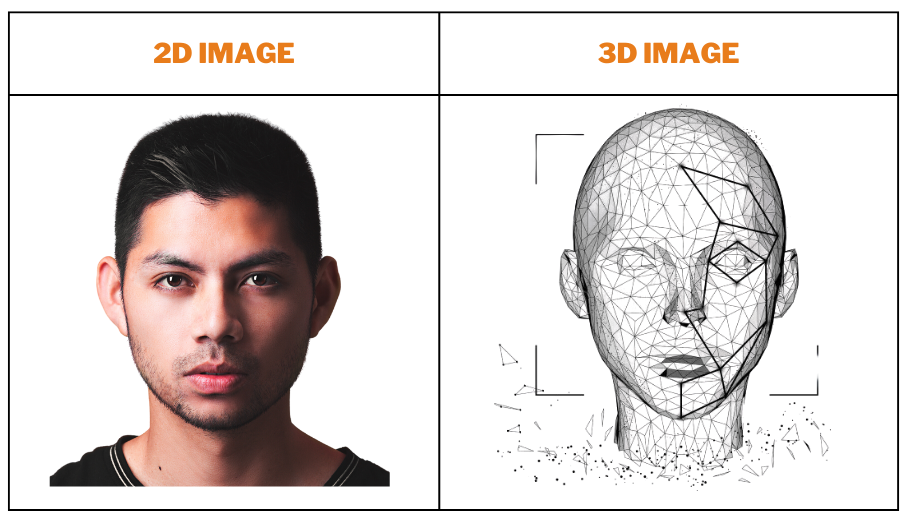
2D Facial Recognition
In 2D facial recognition systems, digital images captured from the camera of a facial recognition access control terminal or smartphone are used to compare and identify faces from a pre-captured image database. This type of facial recognition technology is widely used due to its affordability and ease of implementation compared to other methods.
3D Facial Recognition
3D face recognition technology uses stereoscopic images captured by 3D scanners to create a detailed three-dimensional model of a person's face. This method captures the depth and facial features that go beyond the limitations of 2D images — which also accounts for the differences in lighting and expression.
This method also includes using multiple 2D cameras to capture images and reconstruct a 3D model. Apple’s Face ID system is a good example of this approach. It uses an infrared camera and dot projector to measure facial depth and shape and compares the data against a pre-stored image for identity verification.
What Is Needed For Facial Recognition?
Facial recognition typically requires several components and processes to function effectively:
| Component Required | Function |
|---|---|
| Image Acquisition (Digital Photographic Technology) | A device with digital photographic technology is required to capture the required images and data |
| Feature Extraction | Required for identifying certain facial features and converting them into numerical representations |
| Database | Used to store facial templates extracted from individuals. It serves as a reference later on for comparison during the recognition process |
| Recognition Algorithms | Needed to analyse and compare facial data with stored templates in the database |
| Matching & Decision-making Algorithms | Used to determine whether to accept or reject a match based on a similarity score. |
What Hardware Is Compatible With Facial Recognition?

Any device equipped with photographic capability is compatible with facial recognition systems. This includes mobile phones, laptops, and cameras.
While these devices can run facial recognition software, they each possess limitations that require additional enhancements to ensure improved accuracy and smooth operation.
For example, laptops and mobile phones may lack the necessary resolution in their built-in camera lenses to capture detailed facial images. Additionally, variations in lighting conditions can impact the quality of face capture — which requires adequate illumination for accurate detection.
Fortunately, these limitations can be overcome by incorporating camera flashes or supplementary light sources to effectively illuminate subjects even in challenging lighting scenarios. These measures ensure that facial recognition operates optimally, mitigating the impact of minor constraints.
Bottom Line
Facial recognition technology has revolutionised the world of business and its usage is becoming more widespread every day. Companies are now leveraging its benefits which include heightened security features, contactless authentication capabilities, greater efficiency, and personalisation options that cater to customers' convenience needs.
Because of this, businesses must implement stringent security measures to ensure the responsible and ethical use of facial recognition technology. This includes things such as encryption, secure data storage, and consistent monitoring of the system.
Related articles

Spotting Fake IDs: How Hologram Tech Keeps Online Sign-Ups Safe

Fraud Prevention Best Practices: Staying Ahead in the Digital Age
Fraud has evolved into one of the most pressing challenges for businesses in the digital age, specifically in industries where trust and identity verification are critical, such as banking, insurance, telecommunications, and e-commerce. Fraudsters are after one thing, and one thing only: your perso
Fraud Prevention in the Digital Age: How AI is Transforming the Fight Against Scams
The onset of the digital age has ushered in remarkable innovations that we never would have thought possible a decade ago. Everything, from the way we work to the way we live our daily lives, has been drastically streamlined by technological advances. However, this progress comes with a double edge