
Facial Recognition Use Cases in Banking & Financial Industry - How are the Chinese Leading in AI Tech Adoption?
When speaking about AI (artificial intelligence) and deep learning technologies, the Chinese are not just innovating at rocket speed, but the businesses are rapidly adopting these technologies in real-life business use cases to optimise customer experience and expanding market reach. Let's have a look at how the Chinese banking and financial industries are using facial recognition in business operations governed by stringent security requirements.
n1. Remote, or Self-Service ID Verification
When a customer has already completed the know-your-customer (KYC) process, the bank would already have the customer's ID photo (either extracted from the ID card, or a facial photo captured during KYC). As the customer repeatedly progresses his banking and financing needs with a bank or financial institutions, why can't the customer apply for a new product or service, from the comfort of his/her couch at home/office?
Alipay (an asset of Alibaba's Ant Financial and world's largest mobile payment platform since 2014 Q2), China Merchants Bank (as of 2015, it ranks third of all Chinese companies for net cash), China CITIC Bank (China's seventh-largest lender in terms of total assets), Bank of Jiangsu and Ping An Bank are using facial recognition API to accomplish remote ID verification, either through the convenience of a mobile app, or a self-service kiosk/ATM/VTM.
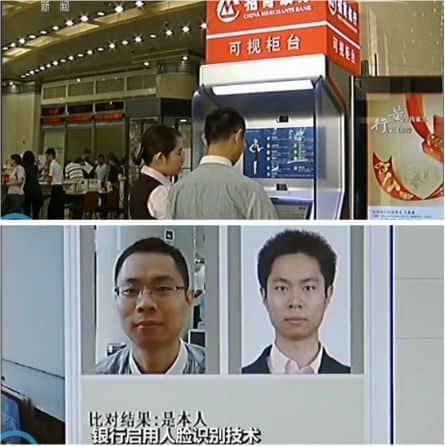
China Merchants Bank's Self-Service ATM equipped with Facial Recognition Technology for ID Verification

Remote ID Verification from Mobile App
Some of these case studies are cited to have only 0.001 error rate at 98% True Positive Rate. If you assigned a human to perform 10,000 verifications in a day, how many mistakes do you think a human would have done?
n2. To Replace Password, or, To Serve as 2FA (Two Factor Authentication)
The Alipay app has a feature that enables users to enrol his/her facial photo as biometric login. Instead of keying in the password, the app recognises the user's face, and logs the user into his/her account upon successful verification.

Screenshot from TechNode
In use cases where an even more stringent security requirement is to be met, facial recognition can serve as part of the 2FA (Two Factor Authentication) process. Imagine ATM machines fitted with camera that performs facial ID verification, in addition to the ATM card PIN number. Why not?
China Merchants Bank is using facial recognition to realise card-less withdrawal at ATM machine. Instead of relying on ATM card and PIN, customers can also perform cash withdrawal through a combination of facial verification plus one-time-pin delivered to mobile phone.
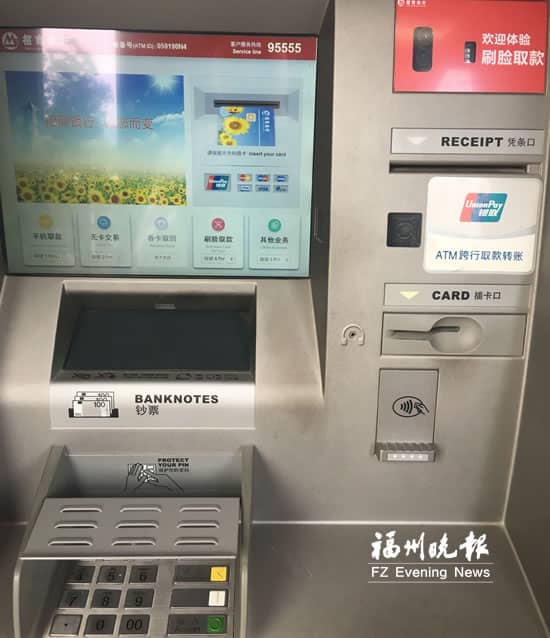
Photo from Xinhuanet
n3. Human-Aided KYC (Know-Your-Customer)
Another use case that has been widely implemented, is to rely on machine to determine the "yes" or "no" of customer's facial sighting process, over-the-counter, aided by banking staff. This process has been around in airport immigration check-points for some time. Instead of trusting on human to make the decision of facial verification, robot is entrusted instead - not susceptible to mood, fraud, and careless mistake.
n4. Smile to PAY!
At CeBIT 2015, Alibaba's Jack Ma demonstrated "smile to pay"! The app validates mobile payments by matching a photo taken by the user at the point of purchase to a stored profile photo.
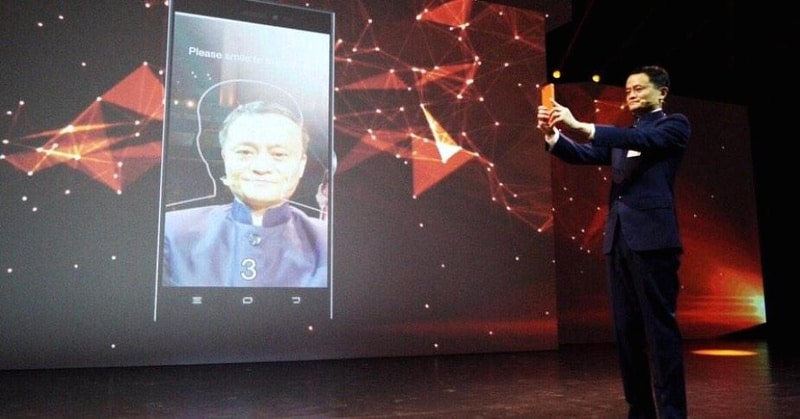
Photo from CNBC
How Does Automated Facial Recognition System Prevent Attacks?
In facial recognition, the first most prominent attack to be mitigated, is the attack against live face by using photo, video or mask as impersonation. A proven facial recognition technology for ID verification should include a client component that performs detection and cropping of face, and intelligent enough to differentiate between a live face and otherwise through combination of the following capabilities:
- live face detection
- face movement tracking
- facial landmark detection
- facial landmark movement tracking (e.g. mouth movement, eye blink, head movement)
- fundamental facial feature analysis
- photo analysis (mathematical analytics to detect photo/video/mask)
The next time when you see someone looking at his smartphone and moving his head, opening his mouth, he may not be Snapchatting; he could be performing a banking transaction or applying a financing facility!
Related articles
Spotting Fake IDs: How Hologram Tech Keeps Online Sign-Ups Safe
Fraud Prevention Best Practices: Staying Ahead in the Digital Age
Fraud has evolved into one of the most pressing challenges for businesses in the digital age, specifically in industries where trust and identity verification are critical, such as banking, insurance, telecommunications, and e-commerce. Fraudsters are after one thing, and one thing only: your perso

Fraud Prevention in the Digital Age: How AI is Transforming the Fight Against Scams
The onset of the digital age has ushered in remarkable innovations that we never would have thought possible a decade ago. Everything, from the way we work to the way we live our daily lives, has been drastically streamlined by technological advances. However, this progress comes with a double edge