
4 Security Automation Facts for Securing Your Business.
Manual security protocols are increasingly expensive and inefficient to sustain — with hackers and fraudsters employing automated systems for their attacks.
Hence, businesses need to combat artificial intelligence (AI) with AI, automating repetitive tasks and integrating threat intelligence within security systems. Your company’s digital security and processes need to keep up with the complex and face-paced cybersecurity environment, especially when attacks are becoming global.
Implementing automated solutions such as Security Orchestration, Automation and Response (SOAR) would be one of the quick wins that mid-sized businesses can look into. Generally, SOAR automatically assesses, detects, intervenes, and searches through security incidents and processes, eliminating any need for human intervention.
Albeit the skepticism of automation being integrated into security systems, it has proven to provide more benefits than drawbacks.
It Keeps The Costs Down

One of the main concerns of automation is the cost that businesses need to bear in maintaining it. However, automation actually does the exact opposite. In recent years, IBM reported that businesses that implement automated cyber security saved US$ 3.05 million per data breach, compared to those that did not.
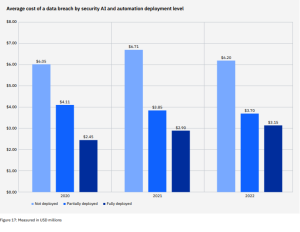
By implementing automation, Swimlane reported that the time to resolve an incident is reduced by 70 to 95%, showcasing cost-effectiveness and increased staff efficiency. This was proven by a real-life example of a Fortune 100 company that saved US$ 160,000 monthly by automating 3,700 hours of work.
Furthermore, businesses will spend less on paying for myriads of cyber tools. With the implementation of an automated system, these tools will be unified into one integrated solution, reducing costs in maintenance and manpower.
Maximising Efficiency Among Employees
Cybersecurity automation has demonstrated its ability to boost IT productivity and efficiency. In a 2020 cyber security survey conducted by Stott and May, 76% of IT executives reported that automation and AI has maximised their productivity and efficiency.

However, mid-sized companies might not be ready to employ a full-fledged security team, leaving them exposed and at risk. Nevertheless, this gap can be temporarily bridged by the use of AI and machine learning (ML) technologies for faster threat mitigation.
SOAR is a prime illustration of an automated workflow and orchestration of security technologies. It streamlines security operations with AI-driven endpoint detection and response (EDR) solutions that detect and take proactive measures against malicious anomalies.
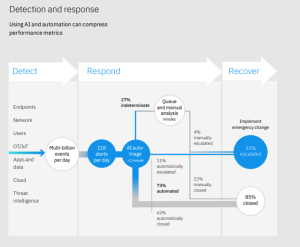
Through this exercise, threats can be quickly processed and analysed, ensuring security teams to quickly identify, respond and contain higher-level threats. Hence, this mitigates the potential breach to sensitive data and minimises risks for organisations. A graph from IBM’s AI And Automation For Cybersecurity (below), showcases the swift actions that can be taken by employing automation.
Reduces Manual Errors

Human error is another common cause of security incidents. In a security context, human errors are unintentional actions or inactions that allow a breach to occur, resulting in significant damage to an organisation. According to a recent report by Verizon (graph below), 82% of cyber security breaches are caused by human elements.
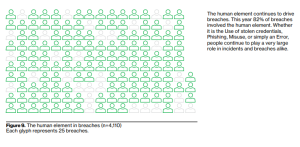
Therefore, automation in cyber security is a critical tool for reducing manual errors and increasing risk analysis efficiency. By automating the process of vulnerability management, businesses are able to identify and remediate any high-threat anomalies.
In addition, this helps businesses to prioritise and allocate their resources to analyse as well as fix any problems within their system. This allows IT teams to focus their efforts to stay ahead of hackers and prevent any unwanted breaches.
Reduces Threat Landscape
Automation in cybersecurity plays a critical role in reducing the threat landscape of a business. In our previous article, we mentioned about identity access management and how human errors can occur. When this error occurs, organisations are at risk of a potential cyber security threat.
Ponemon Institute reveals that there has been a 44% rise for incidents related to insider threats over the past two years, with costs per incident up more than a third to US$ 15.38 million. Therefore, businesses today implement a zero-trust policy, a security approach that requires users to authenticate and verify their devices before being granted any access to specific information.
By integrating automation, businesses are able to effectively implement this policy by providing real-time visibility and control over their network and devices. Compared to a traditional security perimeter, automation immediately detects any malicious activities happening in the background and responds accordingly. This creates a limitation to the attackers ability to escalate their next move.
Has Automation Changed The Course of Our Jobs in Cyber Security?
Although automation has proved to be a critical aspect of modern cyber defense, systems are still in need of human intervention. AI provides us with a simpler and easier way to move around with our daily workflow.
Similarly in Innov8tif, we apply and utilise AI to power our EMAS CIDA ecosystem that has helped myriads of businesses from different industries. Through EMAS CIDA, we provide an automated and comprehensive ID assurance process for users to help identify and mitigate online identity fraud.
Being a one-stop centre to all your digital security needs, Innov8tif also provides constant development with our team of experts, so your business is able to focus on the larger picture at hand.
Learn how the processes of EMAS CIDA can elevate your business security by reading our beginner’s guide to EMAS CIDA, or get in touch with our team at sales@innov8tif.com.
Related articles

Spotting Fake IDs: How Hologram Tech Keeps Online Sign-Ups Safe
Fraud Prevention Best Practices: Staying Ahead in the Digital Age
Fraud has evolved into one of the most pressing challenges for businesses in the digital age, specifically in industries where trust and identity verification are critical, such as banking, insurance, telecommunications, and e-commerce. Fraudsters are after one thing, and one thing only: your perso

Fraud Prevention in the Digital Age: How AI is Transforming the Fight Against Scams
The onset of the digital age has ushered in remarkable innovations that we never would have thought possible a decade ago. Everything, from the way we work to the way we live our daily lives, has been drastically streamlined by technological advances. However, this progress comes with a double edge